The worksheet is a columnar sheet of paper on which accountants have summarized information needed to make the adjusting and closing entries and to prepare the financial statements. A worksheet is only a tool used by accountants and is not part of the formal accounting records. Worksheets may be used each time financial statements are to be prepared, that is; monthly, quarterly, or at the end of the accounting year.
The steps in the preparation of the worksheet are as follows:
1. Enter the titles and balances of ledger accounts in the Trial Balance columns.
2. Enter adjustments in the Adjustments columns.
3. Enter adjusted account balances in the Adjusted Trial Balance columns.
4. Extend adjusted balances of revenues and expense accounts from the Adjusted Trial Balance columns to the Income Statement columns.
5. Extend adjusted balances of assets, liabilities, and owner's equity accounts form the Adjusted Trial Balance columns to the Balance Sheet columns.
The Trial Balance Columns
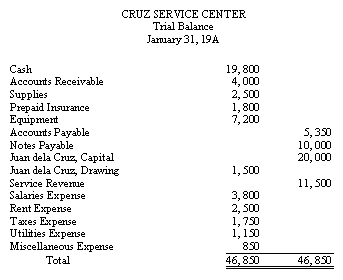
The trial balance prepared after posting is copied in the trial balance column of the worksheet. The titles of each ledger accounts are entered on the description column of the worksheet. Usually, only those accounts with balances as of the end of the accounting period are listed. Alternatively, all of the account titles in the chart of accounts could be listed, even those with zero balances. The balances of the ledger accounts are entered in the first two amount columns of the worksheet, and the columns are totaled. If the debit and credit column totals are not equal, an error exists and will need to be found and corrected before proceeding with the worksheet.
To illustrate the preparation of a worksheet, assume the following trial balance for Cruz Service Center:
The Adjustment Columns
As you learned earlier, adjustments are required to bring the accounts up-to-date prior to preparing the financial statements. Adjustments are entered in the worksheet in the Adjustments columns. The debits and credits of the entries are cross-referenced by placing a key letter to the left of each amount. This key letter facilitates the actual journalizing of the adjusting entries later without having to "rethink" the adjustments in order to record them. For example, the adjustment debiting Supplies Expense and crediting supplies is identified by the letter (a). Note that in the Account Titles column, the Supplies Expense account is written below the totals because it did not have a balance prior to adjustment.
After all adjusting entries have been entered in the Adjustments columns, the two columns are totaled. The totals of the two columns should be equal if all debits and credits have been entered properly. The adjustment for Cruz Service Center are as follows:
(a) Supplies on hand as of January 31, P1, 440.
(b) Insurance expired during the month, P150.
(c) Taxes applicable to future periods, P1, 425.
(d) Depreciation of equipment for the month, P60.
(e) Unearned service revenue performed in January , P2, 450.
(f) Unbilled service revenue performed in January, P2, 450.
(g) Accrued salaries at the end of the month, P160.
The Adjusted Trial Balance Columns
An adjusted trial balance is the original trial balance plus or minus the adjustments. If the item appears as a debit in the Trial Balance, and there is a credit in the Adjustment column, subtract the two amounts and extend the difference on the Adjusted Trial Balance on the side of the larger amount. If the item appears as a debit in the Trial Balance, and the Adjustment is also a debit amount, add and extend the total on the debit side of the Adjusted Trial Balance. We add also accounts with credit balances in the trial balance and credit amounts in the adjustments.
All accounts having balances are extended to the Adjusted Trial Balance columns. Note that some account balances remain the same because no adjustments have affected them. These account balances are simply extended to the Adjusted Trial Balance columns in the worksheet. The Adjusted Trial Balance debit and credit columns are totaled and the totals must be equal before taking the next step in completing the work sheet. If the Trial Balance columns and the Adjustments columns both balance but the Adjusted Trial Balance columns do not, a math error or an error in extension in extension are the most likely causes.
The Adjusted Trial Balance columns are not essential, but they make the next step of sorting the amounts to the Income Statement and Balance Sheet columns much easier.
The Income Statement Columns
All revenue and expense account balances in the Adjusted Trial Balance columns are extended to the Income Statement columns. Since revenues carry credit balances, they are extended to the credit column; expenses are extended to the debit column.. each column is then subtotaled. If the total revenue exceeds the total expenses, the difference is the net income which is added to the debit column in order to bring the two columns into agreement.
The Balance Sheet Columns
Assets, liabilities, and owner's equity accounts listed in the Adjusted Trial Balance columns are extended to the Balance Sheet column—assets as debits and liabilities and owner's equity amounts as credits. Note that the beginning, rather than the ending, balance of owner's capital is carried into the credit column because closing entries have not yet been prepared and posted.
Note also that the net income that was determined in the Income Statement columns appears again in the Balance Sheet columns. The net income amount was shown as a debit in the Income Statement columns in order to force balance those columns. Net income is shown as a credit in the Balance Sheet columns because it increases owner's equity or capital, an increase in owner's equity is accounted for as credits. With the inclusion of the net income amount, the Balance Sheet columns balance.
PREPARING FINANCIAL STATEMENTS FROM THE WORKSHEET
When the worksheet has been completed, all the information needed to prepare the income statement, statement of owner's equity, and balance sheet is readily available. Now the information only needs to be recast into the appropriate financial statement format.
Income Statement
Information needed to prepare the income statement can be taken form the Income Statement columns in the worksheet. The income statement for Cruz Service Center is illustrated below:
Capital Statement
The capital statement (also called statement of owner's equity) is a financial statement that summarizes the transactions affecting the owner's capital account balance. Information needed to prepare this financial statement is taken form the Balance Sheet columns in the worksheet. Such a statement is prepared by showing the beginning capital account balance, adding net income ( or deducting net loss), and then subtracting the owner's withdrawals. The ending capital balance is then carried forward to the balance sheet. The capital statement helps to relate income statement information to balance sheet information; it indicates how net income, shown on the income statement relates to the amount of owner's capital, shown on the balance sheet under owner's equity.
The balance sheet presented above is a classified balance sheet. A classified balance sheet subdivided some of the three major categories in order to provide more specific information for the users of financial statements. For example, assets may be subdivided into many different categories. At this point, we will divide assets into (1) current assets and (2) property, plant, and equipment. Liabilities may be classified as either current or ling-term. Owner's equity for a single proprietorship cannot be subdivided into classifications.
Current assets are cash and other assets that will be converted into cash or used up by the business in relatively short period of time, usually a year or less. Current assets commonly found in a service-type business include cash, accounts and notes receivable, and prepaid expenses. Current assets are normally listed in order or liquidity, or how easily they are convertible into cash. Property, plant, and equipment are assets acquired for use in a business rather than for resale.
Property, plant, and equipment also are termed plant assets, or fixed assets. To agree with the order in the heading, items within property, plant, and equipment are usually listed in that order (property first and equipment last) and are called "fixed" assets because they are used for long-term purposes.
Current liabilities are debts, usually due within one year, the payment of which normally will require the use of current assets. Current liabilities are normally listed in order of how soon they must be paid; the sooner a liability must be paid, the earlier it normally is listed.
Long-term liabilities are those debts not due for a relatively long period of time, usually more than one year. Maturity date should be shown in the balance sheet for all long-term liabilities. Normally, the ones with the earliest due date are listed first.
JOURNALIZING AND POSTING THE ADJUSTING ENTRIES
The adjusting entries recorded in the worksheet must also be recorded in the journal and later posted to the ledger so that the balances of the accounts in the ledger will conform with the balances shown in the financial statements. Adjusting entries are recorded on the next available space in the journal. These entries may or may not be explained. If no explanation is required, the series may be presented first entry. These entries are also posted in the usual manner except that the word "Adjusting" is written on the items column to differentiate it from other posted entries.
The preparation of a worksheet does not eliminate the need to prepare and post adjusting entries because the worksheet is only an accounting tool and is not part of the formal accounting records. The adjusting entries of Cruz Service Center are journalized as follows:
THE CLOSING PROCESS
The closing entries are series of entries required at the end of the fiscal period to bring the balances of the temporary accounts to zero so that they will be ready to receive data for the next accounting period. These temporary accounts are the revenue, expenses, and drawing accounts. They are closed at the end of each period so that their balances may be identified by the year of their occurrence. Hence, we say the sales of 1992 must not include the sales of 1993.
In the closing process, we use a clearing account called "Income Summary". After all revenue and expense account balances have been transferred to Income Summary, its balance represents the net income or net loss for the period. The balance in the Income account is then closed, or transferred to the owner's capital account, resulting in a zero balance in Income Summary. The other terms used are Expense and Revenue Summary, or Profit and Loss Summary.
The steps in the closing process are as follows:
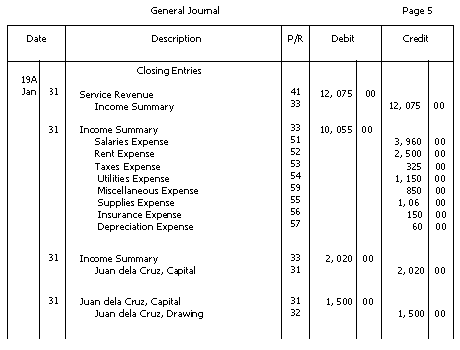
1. Closing the revenue account(s). The balance in the revenue accounts are transferred to the Income Summary account.
a. Each Revenue account is debited for the amount of its balance and,
b. The income summary account is credited for the total revenue.
2. Closing the expense accounts. The balances in the expense accounts are transferred to the Income Summary account.
a. The income summary account is debited for the total expenses, and
b. Each expense account is credited for the amount of its balance.
3. Closing the Income Summary account. The balance of the income summary account is transferred to owner's capital.
a. A credit balance in the income summary account represented net income and it is closed by debiting income summary and crediting the capital account.
b. A debit balance in the income summary account represent net loss and it is closed by debiting the capital account and crediting the income summary account.
4. Closing the owner's drawing account. The balance of the owner's drawing account is transferred to the owner's capital account.
a. The capital account is
debited for the amount of the withdrawals, and,
b. The drawing account is credited for its
balance.
These closing entries are recorded on the next available space in the journal right after the adjusting entries. They are also posted in the usual manner except that the word "closing" is written on the Items column to differentiate it from other posted entries. The closing entries of Cruz Service Center appear on the following page.
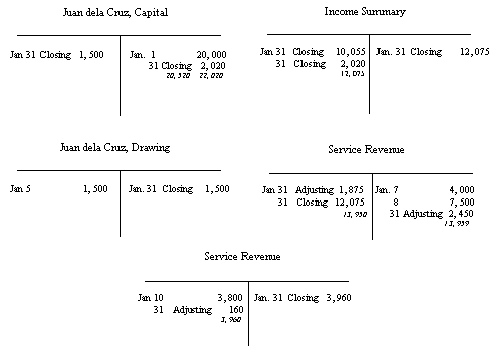
After closing, some of the accounts affected are shown in the following T-accounts. Note that except for the owner's capital account, the other accounts now have zero balance.
POST-CLOSING TRIAL BALANCE
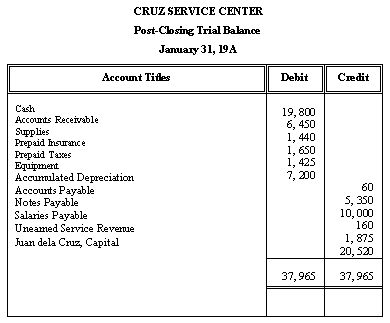
The trial balance prepared after the adjusting and closing processes is called a post-closing trial balance. Sometimes it is also called a balance sheet in a trial balance form, because the items appearing in the post-closing trial balance consists of assets, liabilities, and capital. The temporary accounts have been closed, hence, they are no longer included.
A post-closing trial balance of Cruz Service Center as of January 31, 19A
THE INTERIM STATEMENTS
The statements prepared at the middle of the year are called interim statements. If the company prepares financial statements every end of the month., the statements prepared from January to November are interim statements. The statements prepared at the end of December are called year-end statements.
REVERSING ENTRIES
For certain types of adjusting entries, reversing entries may be prepared as of the first day of the next accounting period. Reversing entries are so named because they reverse the effects of the adjusting entry to which they relate. The purpose of the reversing entry is to simplify the firsts entry relating to that same item in the next accounting period.
Recall the adjusting entry made by Cruz Service Center to recognize accrued salaries of P160. This adjusting entry was made to record salaries that had been incurred but had not yet been paid. Illustrated below are the entries from January 31 through February 10, the next payday assuming (1) no reversing entry is used, and (2) a reversing entry is used.
(1)   Entries when no reversing entry is used	      (2)  Entries when reversing entry is used

	Jan 31 Salaries Expense 	160		     		    Salaries Expense 		160
                Salaries Payable		160					Salaries Payable		160

	  To adjust the accrued salaries		      	    To adjust the accrued salaries.

	Feb 1 No entry.					            Salaries Payable			       160
						             			   	        Salaries Expense              160
							     	             To reverse the adjusting entry made on Jan. 31.

	Feb 10 Salaries Payable	         160                     Salaries Expense             3,  800
	     	 	Salaries Expense   3, 640                                 Cash                                 3, 800
		    		Cash 		      3, 800                       Paid salaries to employees
		      Paid salaries to employees
Whether or not a reversing entry is used, the adjusting entries as of January 31 are the same. The reversing entry dated February 1, shown on the right-hand column above is the exact reverse of the debit and credit used in the adjusting entry. The use of the reversing entry simplifies the entry made on February 10. The accountant does not have to remember that accrued salaries of P16o have already been recorded. When the P3, 800 payment is made, the entry is simply a debit to Salaries Expense and a credit to Cash for P3, 800.
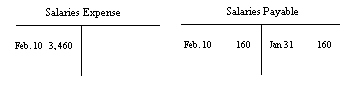
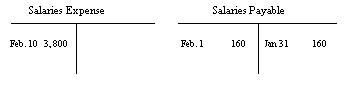
The end result in the accounts is the same whether or not a reversing entry is used. To prove this, the accounts as they would appear are shown below. The beginning balance in the Salaries Payable results from the adjusting entry made on January 31. Adjusting entries from January 31 are not shown since they were the same under either method.
(1) The T-accounts as they appear when no reversing entry is used.
The T-accounts as they appear when a reversing entry is used.
Not all adjusting entries may be reversed on the first day of the next period. Ideal entries for reversal are those relating to situations where cash is going to be paid or received in an adjusting entry. Examples of such items would include accrued salaries and unbilled revenues. Adjustments for items that will not result in a subsequent receipt or payment of cash, such as the adjustment for depreciation, are not reversed. A general rule to follow is that all adjusting journal entries that increase assets or liabilities may be reversed (since they will result in a future cash receipt or payment), but those adjusting entries that decreases assets or liabilities may not be reversed. Thus, adjusting entries that involve accruals of assets (accrued revenues) and liabilities (accrued expense) may be reversed.
We also reverse adjusting entries for prepaid expense recorded under the expense method, and unearned revenues, recorded under the revenue method. Since the revenue and expense accounts are affected by the closing entries made at the end of the period, there is a need for reversing entries in order to revert back to the original method used; namely, the expense method for prepaid expenses and the revenue method for unearned revenue.